

OT Detection Engineering
Engineer What Matters.Detect What Others Miss.
OT Detection Engineering improves visibility, eliminates blind spots, and builds high-confidence detections that protect people, production, and critical infrastructure.
- MITRE ATT&CK for ICS
- Visibility Assessment
- Detection Engineering
- Validation
- Coverage Optimization
- Continuous Improvement
What is OT Detection Engineering?
OT Detection Engineering is the continuous process of designing, validating, measuring, and improving an organization's ability to detect cyber threats across industrial environments.
Detection Engineering is not
- SIEM tuning
- Rule writing
- Alert clean-up
- Dashboard maintenance
- One-time assessments
- "Set it and forget it"
The Problem Nobody Sees
You can’t detect what you can’t see.
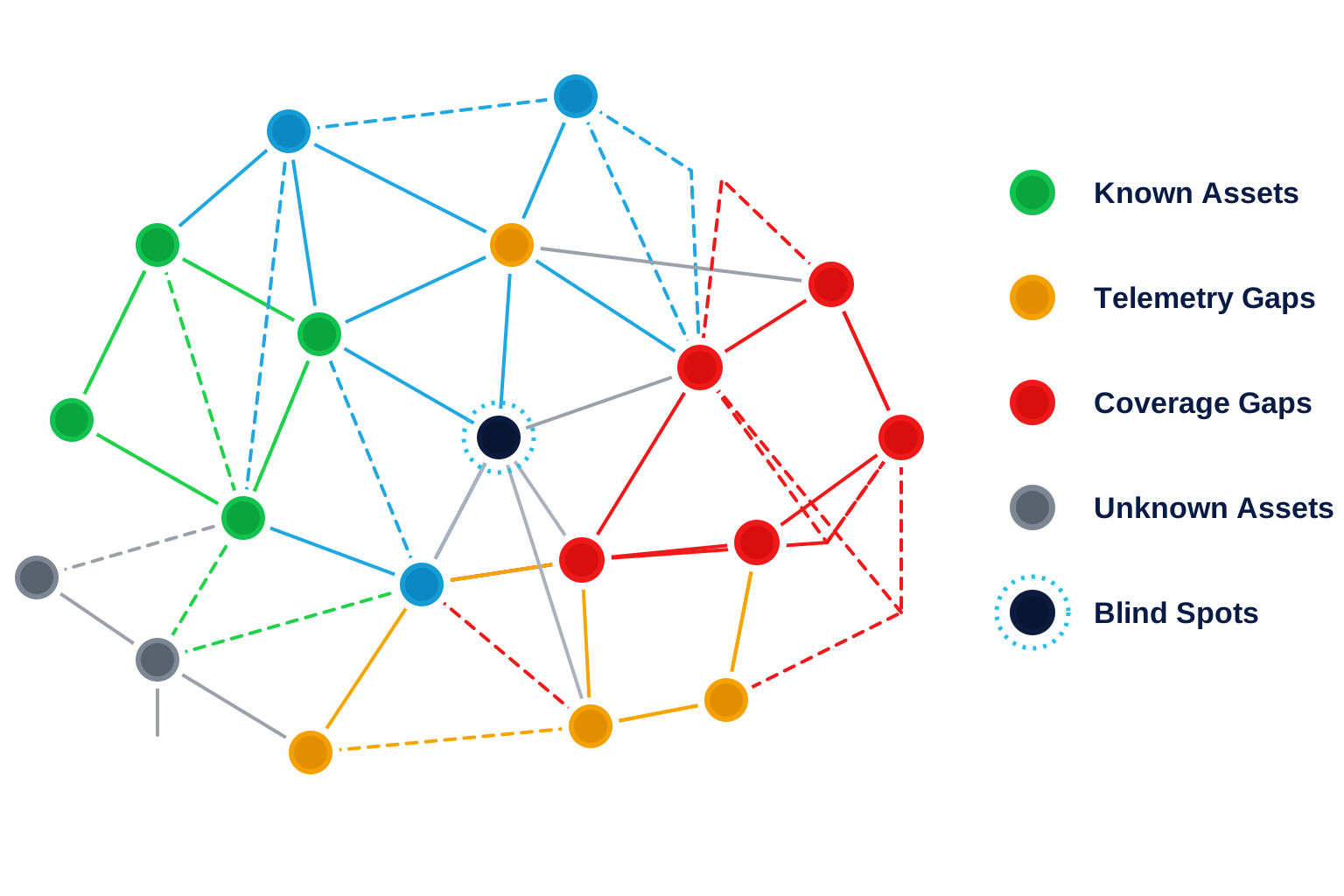
Operational Intelligence starts with visibility.
Why It Matters
- Undetected threats can reach controllers
- Blind spots create unacceptable operational risk
- Poor detections lead to alert fatigue and delay
- Unvalidated detections create false confidence
- You can't improve what you don't measure

Detection Engineering Lifecycle
Discover
Identify assets, telemetry sources, and visibility gaps.
Measure
Assess detection coverage, ATT&CK coverage, and telemetry quality.
Engineer
Develop detection content for OT events and operational contexts.
Validate
Test detections against threat scenarios and adversary behaviors.
Deploy
Implement detections and integrate into operational workflows.
Monitor
Measure performance and analyst feedback in real operations.
Repeat
Continuously improve visibility, coverage, and detection quality.






Every cycle increases visibility, coverage, detection quality, and operational confidence.
Coverage That Matters
We measure and improve the coverage that truly reduces risk.
Telemetry Coverage
The breadth and depth of data collected from across your industrial environment.
We find gaps and ensure you collect the right data from the right places.
Detection Coverage
The ability to detect known threats and suspicious behaviors across MITRE ATT&CK for ICS.
We map, measure, and improve what you can detect today.
Asset Coverage
The percentage of critical assets identified, monitored, and understood.
We discover unknown and unmanaged assets giving you blind spots.
ATT&CK Coverage
How well your detections map to real-world adversary tactics and techniques.
We identify gaps in your ATT&CK coverage and close them.
| Tactic | Coverage |
|---|---|
| Initial Access | 78% |
| Execution | 54% |
| Persistence | 43% |
| Privilege Escalation | 40% |
| Evasion | 60% |
| Discovery | 73% |
| Lateral Movement | 72% |
| Collection | 30% |
| Command & Control | 50% |
| Impact | 43% |
How We Engineer Detections
Our detection engineering process is built around operational reality.
Visibility Driven
We start by understanding what assets, telemetry, and protocols exist.
Operationally Informed
We use MITRE ATT&CK for ICS and real adversary behaviors to prioritize.
Context Aware
We incorporate process, engineering logic, and operational context.
Continuously Improved
We build detections based on validation results and analyst noise.
Detection Intelligence Workspace
A unified workspace that connects data, engineering, validation, and outcomes.
Telemetry Ingestion
Collect from sensors, logs, network, and applications.Coverage Analysis
Identify gaps in telemetry, assets, and detections.Detection Engineering
Build detections aligned to operational context.Validation & Testing
Test and validate for accuracy, coverage, and performance.Metrics & Reporting
Measure results and track improvement over time.Recommendations & Actions
Prioritize actions to improve coverage and reduce risk.
Analyst feedback and operational learning feed back into every stage.
Measuring Detection Quality
We validate detections to ensure they actually work when it matters.
- Detection Validation: test detections against adversary emulations and scenarios.
- False Positive Reduction: improve signal quality and reduce alert fatigue.
- Coverage Validation: confirm detections for critical assets, zones, and attack paths.
- MITRE ATT&CK Mapping: track and improve visible effectiveness.
- Continuous Improvement: feedback loop from analysts to engineers to improve outcomes.
Business Outcomes
- Eliminate blind spots and improve visibility
- Detect threats earlier across the attack lifecycle
- Reduce false positives and analyst fatigue
- Accelerate investigations and response
- Improve operational resilience and uptime
- Strengthen compliance and audit readiness
- Build continuous improvement and confidence
Resources & Insights
Showing 8 of 8 resources.

Article
When Modbus Lies: Detecting Threats Inside Industrial Protocols
Read article
Article
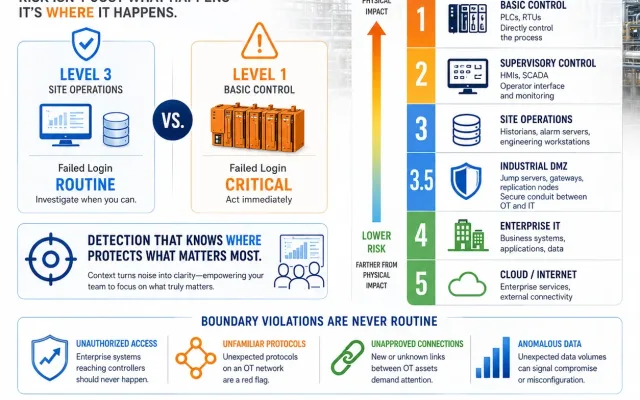
Same Alert, Different Impact
Read article
Article
The CFC as OT Visibility Architecture
Read article
Article
Monitoring the Extended Perimeter: The CFC and OT Vendor Access
Read article
Article
Beyond Vulnerability Scanning
Read article

Podcast
OT Security Behind The Times
Listen now
Article
Mithryl Systems Launches Flagship OT Managed Detection & Response Service
Read article
External Resource
MITRE ATT&CK for ICS
Explore tactics and techniques targeting industrial environments.
Visit site
Frequently Asked Questions
What is OT Detection Engineering?
OT Detection Engineering is the continuous process of designing, validating, measuring, and improving an organization's ability to detect cyber threats across Operational Technology (OT) environments. It combines visibility analysis, detection content development, validation, and ongoing optimization to ensure security monitoring remains effective as industrial environments evolve.
Unlike one-time SIEM tuning, Detection Engineering is a continuous operational discipline that improves detection quality over time.
Why is OT Detection Engineering important?
Many organizations have cybersecurity tools but lack confidence that those tools can reliably detect threats targeting industrial environments. Detection Engineering identifies blind spots, validates detection effectiveness, reduces false positives, and continuously improves coverage so organizations can detect attacks before they impact production or safety.
The goal is not simply to collect more telemetry, but to ensure the right telemetry produces meaningful, actionable detections.
How is OT Detection Engineering different from SIEM tuning?
SIEM tuning typically focuses on reducing noise, improving alert quality, and optimizing system performance.
OT Detection Engineering is much broader. It evaluates telemetry sources, validates detection coverage, measures effectiveness against real-world attack techniques, identifies visibility gaps, develops new detection content, and continuously improves an organization's overall detection capability.
SIEM tuning is one activity within Detection Engineering, not the entire discipline.
What problems does OT Detection Engineering solve?
OT Detection Engineering helps organizations identify and resolve issues such as:
- Unknown or unmanaged assets
- Missing telemetry
- Detection blind spots
- Poor visibility across industrial environments
- Excessive false positives
- Low-confidence detections
- Gaps in ATT&CK for ICS coverage
- Detection content that no longer reflects current threats
By addressing these issues, organizations improve both cybersecurity visibility and operational resilience.
What is a detection blind spot?
A detection blind spot is an area of the environment where malicious activity could occur without generating meaningful security alerts.
Blind spots may result from missing telemetry, unmanaged assets, incomplete network visibility, or gaps in detection content.
Detection Engineering identifies these blind spots and develops strategies to eliminate them.
How does Mithryl Systems identify visibility gaps?
Mithryl Systems evaluates available telemetry, asset coverage, network architecture, industrial communications, and existing detections to determine where operational visibility is incomplete.
Rather than assuming every asset is monitored, we verify whether important systems are generating the telemetry needed to detect cyber threats.
This process often uncovers unknown assets, unmonitored systems, and critical detection gaps.
What is MITRE ATT&CK for ICS?
MITRE ATT&CK for ICS is a globally recognized knowledge base that documents adversary tactics, techniques, and procedures targeting industrial control systems.
Mithryl Systems uses ATT&CK for ICS as one method for evaluating detection coverage, identifying defensive gaps, and prioritizing new detection content based on real-world attack behavior.
How do you measure detection quality?
Detection quality is measured by evaluating whether detections reliably identify meaningful threats while minimizing false positives.
Mithryl Systems measures detection quality through validation testing, ATT&CK coverage analysis, operational relevance, analyst feedback, and continuous performance monitoring.
Effective detections should produce actionable intelligence rather than simply generating alerts.
How often should detections be validated?
Detection validation should be an ongoing process rather than a one-time project.
As industrial environments, threat actors, operational processes, and technologies evolve, detections should be continuously tested and refined to ensure they remain accurate, relevant, and effective.
Continuous validation helps prevent detection content from becoming outdated over time.
What telemetry is required for OT Detection Engineering?
Effective Detection Engineering depends on high-quality telemetry from across the industrial environment.
Common telemetry sources include:
- OT network monitoring platforms
- Firewalls
- Engineering workstations
- Active Directory
- Windows OT systems
- Remote access infrastructure
- Industrial protocol monitoring
- SIEM platforms
- OT asset inventories
The exact telemetry requirements depend on each organization's environment and risk profile.
Does Detection Engineering reduce false positives?
Yes.
One of the primary objectives of Detection Engineering is reducing unnecessary alerts while improving confidence in meaningful detections.
By continuously refining detection logic, validating alert behavior, and incorporating operational context, organizations spend less time investigating benign activity and more time responding to genuine threats.
Does Detection Engineering improve ATT&CK coverage?
Yes.
Detection Engineering helps organizations understand which ATT&CK for ICS techniques are currently detectable, where gaps exist, and which new detections should be developed to improve overall coverage.
Rather than chasing arbitrary coverage percentages, Mithryl Systems prioritizes techniques based on operational risk and real-world adversary behavior.
What is the Detection Intelligence Workspace?
The Detection Intelligence Workspace is Mithryl Systems' structured approach for connecting telemetry ingestion, coverage analysis, detection engineering, validation testing, performance measurement, and analyst recommendations into a continuous improvement workflow.
It provides a repeatable process for improving detection capability rather than treating detections as static rules.
Can Detection Engineering work with our existing SIEM and OT security tools?
Yes.
Mithryl Systems follows a vendor-neutral approach and works with existing SIEM, XDR, OT monitoring, and industrial cybersecurity platforms.
Rather than replacing existing technologies, Detection Engineering improves the effectiveness of the tools organizations already own.
How does Detection Engineering improve operational resilience?
Operational resilience depends on detecting threats before they become operational disruptions.
Detection Engineering strengthens resilience by improving visibility, reducing blind spots, validating detections, improving ATT&CK coverage, and continuously refining detection content as threats and environments change.
Better detections enable faster investigations and more confident operational decisions.
How long does a Detection Engineering engagement take?
Detection Engineering is typically delivered as a continuous improvement program rather than a fixed-duration project.
Initial assessments establish visibility, coverage, and detection baselines. From there, detections are continuously validated, measured, optimized, and expanded as operational environments evolve and new threats emerge.
What makes Mithryl Systems' approach to Detection Engineering different?
Mithryl Systems approaches Detection Engineering as an operational capability rather than a technical tuning exercise.
Our methodology combines:
- OT operational context
- Visibility analysis
- ATT&CK for ICS mapping
- Detection content development
- Validation testing
- Continuous optimization
- Augmented Intelligence
- Analyst expertise
- Operational feedback loops
The result is a continuously improving detection capability that supports operational resilience instead of simply generating more alerts.
How do I get started with OT Detection Engineering?
The best place to begin is by downloading the OT Detection Engineering Datasheet to understand our methodology and approach.
Organizations interested in evaluating their current detection capability can also schedule a conversation with a Mithryl Systems OT cybersecurity expert to discuss visibility gaps, telemetry quality, ATT&CK coverage, and opportunities to improve operational detection effectiveness.
Ready to Improve Detection Confidence?
Let's identify your blind spots and engineer detections that protect your operations.