
OT Cyber Fusion Services
OT Digital ForensicsDetermine what happened. Understand why. Preserve what matters most.
OT Digital Forensics reconstructs cyber events across industrial environments by preserving evidence, correlating activity, identifying root cause, and documenting findings that support recovery, compliance, insurance, and future detection improvements.
What Is OT Digital Forensics?
OT Digital Forensics is the disciplined process of collecting, preserving, analyzing, and documenting digital evidence to determine exactly what occurred during a cybersecurity incident in industrial environments.
Digital Forensics is not
- Incident response or containment
- Threat hunting or monitoring
- System remediation or recovery
- Compliance auditing
Why Digital Forensics Matters
Industrial incidents are complex and difficult to prove. Without reliable digital evidence, organizations can be left making decisions from assumptions instead of facts.
- 82%
- of organizations lack clear criteria for what triggers a cyber investigation.— Dragos OT Cybersecurity Year in Review, 2026
- 30%
- of incident response cases begin with unexplained operational issues.— Dragos OT Cybersecurity Year in Review, 2026
- 73%
- of incident response cases involve compromised VPN or jump-host credentials.— Dragos OT Cybersecurity Year in Review, 2026
Accurate forensics provides the proof required to understand the event, meet business and regulatory obligations, and reduce the likelihood of the same incident happening again.
How a Digital Investigation Works
A structured forensic process designed for industrial environments where operational continuity and evidence integrity both matter.
1. Preserve
Secure the environment and preserve volatile and persistent evidence.
2. Collect
Acquire data from relevant systems using forensically sound methods.
3. Correlate
Align and correlate evidence across systems to build a complete timeline.
4. Analyze
Examine artifacts and behavior to determine what occurred and how.
5. Reconstruct
Rebuild the sequence of events and determine operational impact.
6. Report
Document findings, evidence, root cause, impact, and recommendations.
What We Analyze
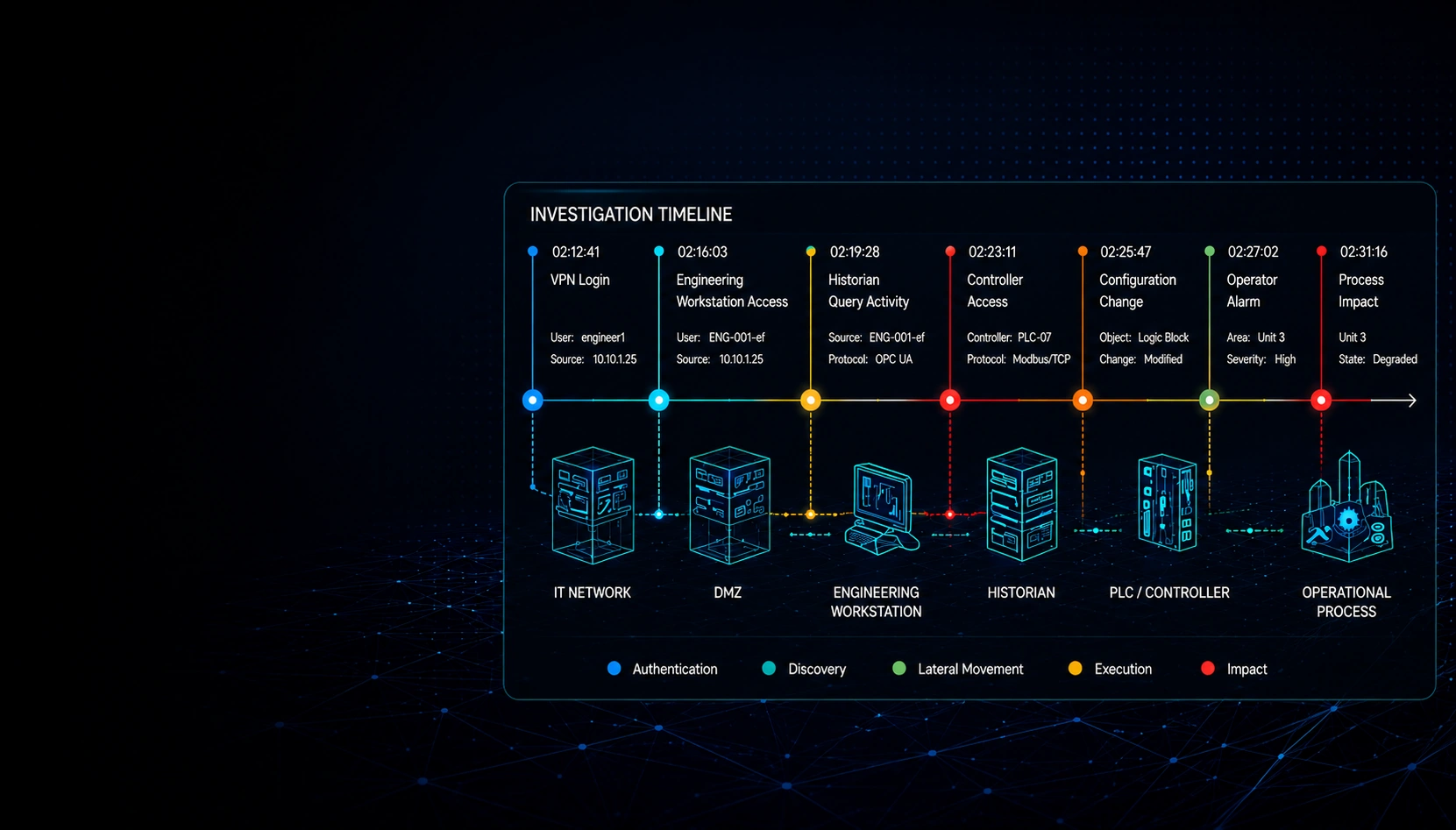
We examine evidence across the OT environment to build an accurate picture of the incident, from the initial point of access through operational impact.
Investigation Scope
User Activity
Logins, privilege use, identity activity, and account behavior.System & Application Logs
Windows events, services, security tools, and application logs.Industrial Systems
PLC communications, configuration changes, firmware activity, and controller artifacts.Network Traffic
Protocol analysis, lateral movement, command and control, and exfiltration behavior.Operational Data
Historian activity, HMI activity, alarms, state changes, and process impact.
Evidence Is Handled With Care
Every engagement follows documented chain-of-custody and evidence-preservation practices.
Admissible
Forensically sound acquisition and documentation methods.Accountable
Chain of custody maintained throughout the investigation.Confidential
Evidence protected through controlled access and secure handling.Defensible
Findings designed to withstand technical and legal scrutiny.
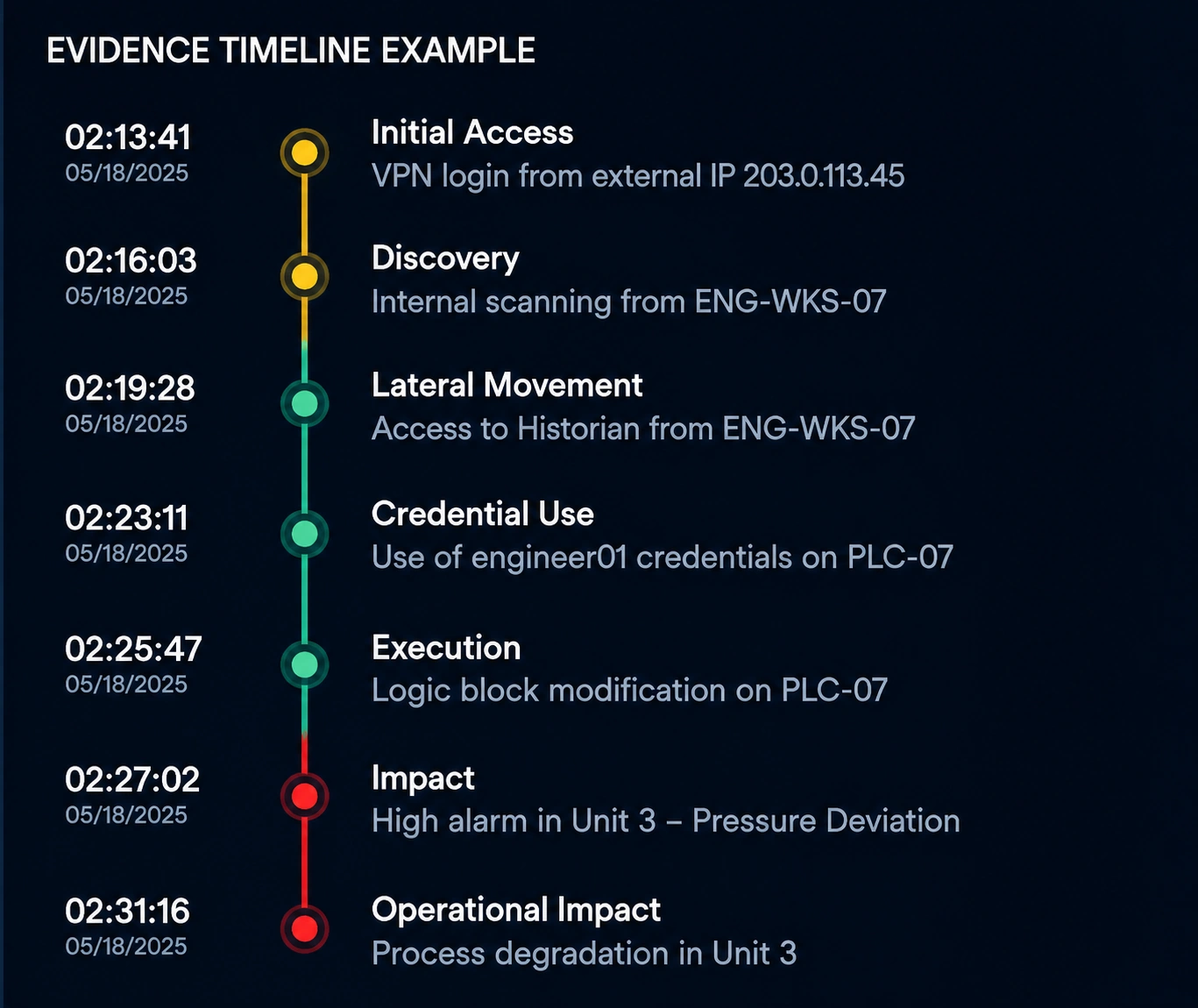
Evidence Timeline Example
A reconstructed sequence is more than a picture — it is a defensible record of what happened, when, and on which systems.
Initial Access
VPN login from external IP 203.0.113.45
Discovery
Internal scanning from ENG-WKS-07
Lateral Movement
Access to historian from ENG-WKS-07
Credential Use
Use of engineer01 credentials on PLC-07
Execution
Logic block modification on PLC-07
Impact
High alarm in Unit 3 — Pressure Deviation
Operational Impact
Process degradation in Unit 3
Evidence Sources
We collect and analyze data from the systems that reveal what actually occurred.
Windows Artifacts
- Event logs
- Registry changes
- Prefetch & ShimCache
- File system artifacts
Historian Data
- OPC queries
- Historical trends
- Tag access
- Data exports
Firewall & Network
- Firewall logs
- NetFlow / IPFIX
- IDS / IPS alerts
- Network captures
Authentication Logs
- Active Directory
- VPN logs
- RADIUS / TACACS+
- Failed logins
Engineering Workstations
- User activity
- File access
- USB usage
- Tool execution
HMI & Operator Activity
- Screen captures
- Alarms & events
- Operator actions
- Audit trails
PLC & ICS Protocols
- Modbus
- DNP3
- IEC 61850
- Vendor protocols
Deliverables You Can Act On
Clear, defensible investigation outputs that support recovery, compliance, insurance, legal review, and future prevention.

Forensic Investigation Report
Findings, timeline, root cause, evidence, and impact assessment.Evidence Timeline
Correlated sequence of attacker and system activity across sources.Root Cause Analysis
What happened, how it happened, and where existing controls failed.Evidence Preservation Package
Collected evidence secured and documented with chain-of-custody records.Regulatory & Legal Support
Documentation supporting reporting, legal review, and insurance claims.Recommendations
Prioritized actions to improve detection, resilience, and prevention.
Clarity Leads to Better Decisions
Forensics provides the evidence needed to make decisions with confidence after an industrial cyber event.
- Determine root cause with confidence
- Support compliance and regulatory reporting
- Provide defensible evidence for legal and insurance needs
- Improve detection engineering and monitoring
- Prevent repeat incidents and reduce future risk
- Strengthen operational resilience

Turn uncertainty into understanding.
Digital evidence helps your organization understand what happened, protect operations, satisfy reporting obligations, and make stronger decisions about what happens next.
Resources & Insights
Showing 6 of 6 resources.
Executive Guide
The Digital Evidence Playbook for OT
Practical steps to preserve evidence and support investigations.
Download (email required)
White Paper
Forensics Readiness in Industrial Environments
Build an environment that supports reliable investigations.
Download (email required)
Report
Industrial Incident Trends and Lessons Learned
Key findings from recent OT incident investigations.
Download (email required)
Case Study
Manufacturing Incident Forensics: What We Found
How evidence uncovered the root cause and prevented recurrence.
Read case study
Webinar
Inside an OT Investigation
Live walkthrough of a real-world industrial forensics case.
Watch now
External Resource
MITRE ATT&CK for ICS
Explore adversary techniques targeting industrial environments.
Visit site
Frequently Asked Questions
What is OT Digital Forensics?
OT Digital Forensics is the process of collecting, preserving, analyzing, and documenting digital evidence from Operational Technology (OT) environments to determine what happened during a cybersecurity incident, how it occurred, and what operational impact it had.
Unlike traditional IT forensics, OT Digital Forensics considers industrial processes, engineering systems, controllers, historians, industrial protocols, and production operations to reconstruct events without compromising evidence or disrupting critical infrastructure.
How is OT Digital Forensics different from Incident Response?
Incident Response focuses on containing threats, minimizing operational disruption, and restoring normal operations.
Digital Forensics focuses on understanding exactly what happened by collecting and analyzing evidence. It reconstructs the sequence of events, identifies root cause, determines attacker activity, preserves evidence for legal or regulatory purposes, and documents findings that support future improvements.
Incident Response answers "How do we recover?" while Digital Forensics answers "What happened and why?"
Why is Digital Forensics important in industrial environments?
Industrial incidents often involve physical operations, safety systems, regulatory obligations, and business continuity.
Without accurate forensic evidence, organizations may never fully understand how attackers gained access, what systems were affected, what operational consequences occurred, or how to prevent similar incidents in the future.
Digital Forensics transforms uncertainty into evidence-based decision making.
What types of evidence are collected during an OT forensic investigation?
Evidence varies depending on the environment but commonly includes:
- Windows event logs
- Active Directory logs
- Firewall logs
- Historian data
- HMI activity
- Engineering workstation artifacts
- PLC and controller configuration data
- Authentication records
- Network captures
- Industrial protocol communications
- Process alarms
- Maintenance logs
- Asset inventories
Each evidence source contributes to reconstructing the complete sequence of events.
What is chain of custody?
Chain of custody is the documented process used to track digital evidence from collection through analysis and storage.
Mithryl Systems follows strict forensic procedures to ensure evidence remains complete, authentic, and defensible throughout an investigation. Maintaining chain of custody is essential for regulatory reporting, insurance claims, legal proceedings, and executive confidence.
How does an OT digital investigation work?
Mithryl Systems follows a structured forensic methodology designed for industrial environments.
Typical investigations include:
- Preserve the environment and protect evidence.
- Collect forensic artifacts using sound methods.
- Correlate evidence across multiple systems.
- Analyze attacker activity and operational impact.
- Reconstruct the timeline of events.
- Produce documented findings and recommendations.
This repeatable process ensures investigations are accurate, defensible, and operationally relevant.
What systems can be analyzed during an OT forensic investigation?
Depending on the incident, investigations may include:
- Engineering workstations
- Human Machine Interfaces (HMIs)
- Historians
- Windows servers
- Active Directory
- Firewalls
- Industrial network monitoring platforms
- PLC-related evidence
- Authentication systems
- Remote access infrastructure
- Operational logs
- Network traffic
The scope of analysis is determined collaboratively based on the incident and operational priorities.
Can digital evidence be collected without disrupting operations?
Yes.
Mithryl Systems uses forensic methodologies designed specifically for industrial environments. Evidence collection is carefully planned to minimize operational impact while preserving the integrity of critical systems and maintaining production whenever possible.
Protecting operational continuity is a core principle of every engagement.
How long does an OT forensic investigation take?
The duration depends on the complexity of the incident, the number of affected systems, the amount of available evidence, and organizational requirements.
Initial evidence preservation typically begins immediately, while complete forensic analysis and reporting may continue over several days or weeks depending on the scope of the investigation.
What deliverables are provided after an investigation?
Every investigation produces evidence-based deliverables designed for both technical teams and executive leadership.
Typical deliverables include:
- Forensic Investigation Report
- Evidence Timeline
- Root Cause Analysis
- Evidence Preservation Package
- Regulatory and Legal Support
- Executive Summary
- Operational Recommendations
These deliverables provide organizations with clear documentation for recovery, compliance, and future improvements.
Can Digital Forensics support regulatory reporting?
Yes.
Digital Forensics provides documented evidence that supports investigations required by regulatory agencies, auditors, and internal governance teams.
Evidence collected during investigations can help organizations satisfy reporting requirements, demonstrate due diligence, and support compliance with applicable cybersecurity regulations.
Can Digital Forensics support cyber insurance claims?
Yes.
Many cyber insurance providers require organizations to document what occurred during an incident before processing claims.
Mithryl Systems' forensic investigations provide defensible evidence, documented timelines, root cause analysis, and supporting documentation that may assist organizations during insurance investigations and claims processes.
How does Mithryl Systems protect digital evidence?
Evidence is collected using forensically sound methods and handled according to documented preservation procedures.
Every stage of the investigation follows strict administrative, technical, and procedural controls to ensure evidence remains complete, secure, and defensible throughout the investigation lifecycle.
What makes OT Digital Forensics different from traditional IT forensics?
Traditional IT forensics focuses primarily on recovering digital evidence from enterprise systems.
OT Digital Forensics incorporates industrial processes, engineering workflows, operational technology, production systems, and physical consequences into every investigation.
The objective is not only to determine what happened but also to understand how cyber events affected operational resilience, production, safety, and critical infrastructure.
What makes Mithryl Systems' Digital Forensics approach different?
Mithryl Systems combines cybersecurity expertise with operational understanding.
Our investigators analyze evidence within the context of industrial operations, engineering processes, and business objectives rather than viewing incidents solely through an IT security perspective.
Our investigations emphasize:
- Operational context
- Evidence preservation
- Root cause analysis
- Executive reporting
- Regulatory support
- Practical recommendations
- Continuous operational improvement
This approach helps organizations recover, learn, and strengthen their operational resilience.
How do I get started with OT Digital Forensics?
Organizations can begin by downloading the OT Digital Forensics Datasheet to learn about our investigation methodology, deliverables, and forensic capabilities.
If your organization is responding to an active incident or requires forensic expertise, you can also request a forensic consultation with a Mithryl Systems specialist to discuss your situation, preserve critical evidence, and determine the appropriate next steps.
Need Answers After an Incident?
When the event is over, the questions begin. Mithryl Systems helps reconstruct what happened, preserve the evidence, and give your organization the clarity to move forward.